
Client: RSL Construct (JV Coussée and ION)
Location: Roeselare
Execution period: Start early 2023 – completion in Q2 2025

The former Sacred Heart Hospital in Roeselare, a place associated with memories for many, is making way for a new chapter. RSL Construct assigned Verhelst Aannemingen to dismantle and completely demolish the hospital in a safe, efficient, and sustainable manner.
The work was carried out in two major phases. In the first phase, the focus was on pre-dismantling, where the building was prepared for asbestos removal and subsequent demolition. In the second phase, the existing asbestos was expertly removed, with the majority located in plasterwork that had to be removed in hermetically sealed zones. This required a very precise and controlled approach to ensure the safety of the surroundings.

A significant project
The project was of considerable scale. In total, 22,000 m² of plaster was removed in hermetic zones, along with 30,000 m² of drywall. The volume of the hospital to be demolished was no less than 174,500 m³. During the demolition, 16,000 m³ of rubble, 21,000 m³ of concrete, and 540 tons of wood were also released.


Sustainability is key
Sustainability played a central role in this project. The old roofing was recycled and brought back to the factory to make new roofing. Additionally, we collaborated with a student from the University of Ghent, who conducted research on the reusability of insulation materials. He investigated, among other things, whether certain insulation elements could remain in place or be recovered, depending on their quality upon removal.
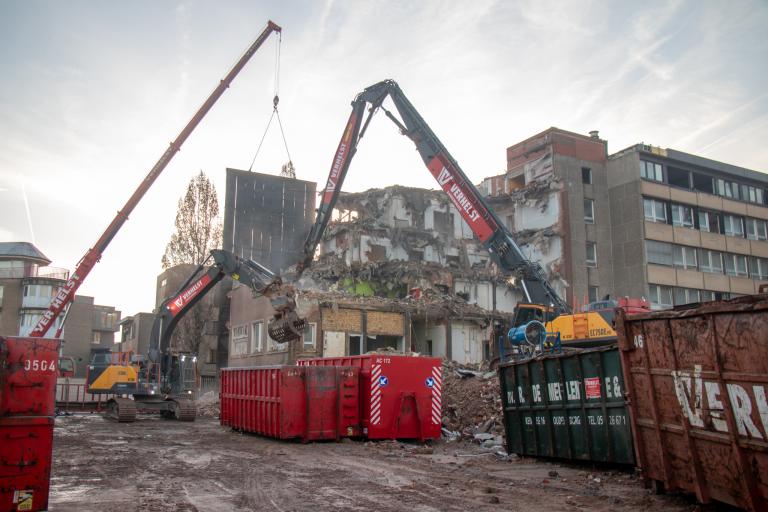
The progression of the demolition works
To minimize the inconvenience for the neighborhood, it was decided to carry out all work – from dismantling to asbestos removal – from the central courtyard. To make this courtyard easily accessible, the middle sections 'V' and 'P' were first removed. In block A, a passage was created to evacuate materials and debris easily. Only after the courtyard was cleared, did the actual demolition of the surrounding buildings begin.
An impressive array of machinery was used for the demolition. We worked with bobcats and mini excavators for dismantling, and two large demolition cranes – one with a reach of up to 37 meters. During peak times, up to seven cranes were simultaneously at work, including crushers, sorting buckets, and cranes with concrete shears. It was a busy, well-orchestrated construction site.
An additional challenge was the presence of an underground stream under blocks A and I. Because it was not visible, the heavy machinery had to be carefully positioned to maintain stability. The location in an urban environment also brought additional considerations, such as dust and noise control, particularly near a school. Thanks to smooth communication with the City of Roeselare, the permit applications and coordination went exceptionally efficiently.


